

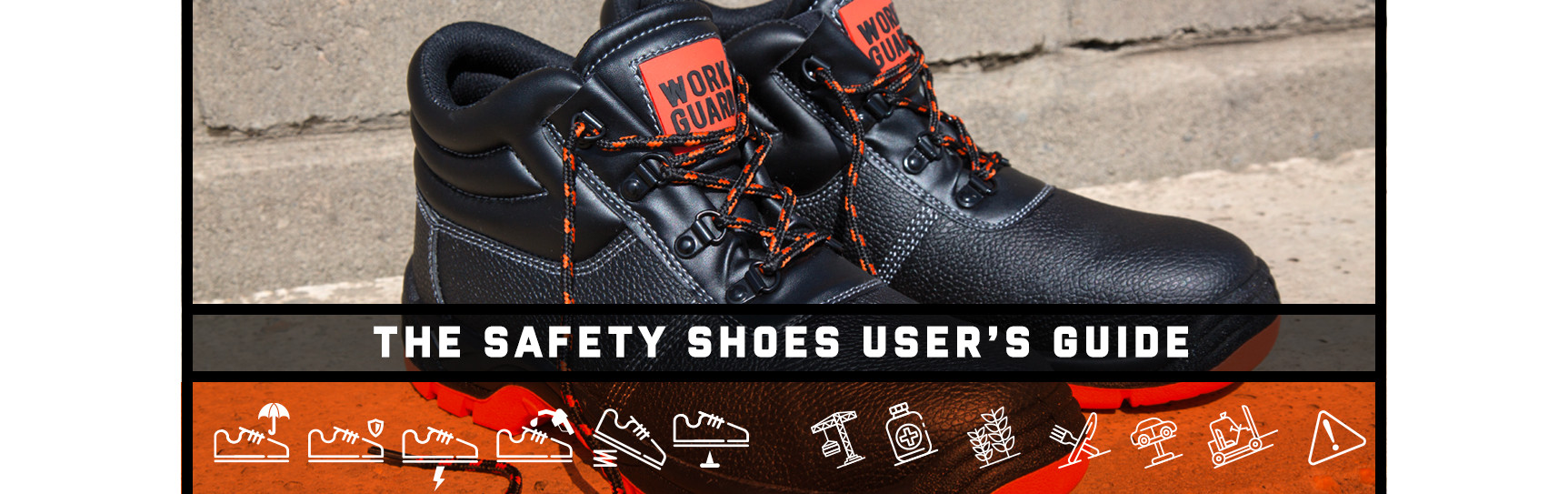
The safety shoes user’s guide
The safety shoes user’s guide
Discover our feed/news feed
How to choose the right safety shoes?
Safety shoes are important PPE (Protective Equipment), they are even mandatory for some occupations.
They protect you during the course of your professional tasks. The shoes do not only have to comply with the requirements of your working environment, but they also have be comfortable.

1 / Advantages
- Prevent accidents;
- Work more comfortably and more efficiently;
- Protect your feet from possible accidents;
- Respect the legal aspects;
- Resistant.
2 / Choose better : Know the standards
Safety shoes are classified in several catagories. They can be found under different safety classes:

3 / Uses
Safety shoes are great prevention tools against:
- Slips
- Crushings
- Lacerations
- False moves
To choose the right safety shoes, it is important to take into account the circumstances
in which they will be worn:
- Weather conditions
- Incurred dangers
- Comfort

4 / Other criteria
The safety toecaps are made of steel or composite material.
- Metal safety toecap: more classic and better resistance to direct impact.
- Composite safety toecap: Lighter than the standard steel toecap, regulating temperature (cooler in summer, warmer in winter), anti-magnetic and anti-static, non-detectable by metal detectors.
The anti-perforation midsoles are impenetrable midsoles that protect the feet against object penetrations. They come with or without metal:
- metal insert-soles are less vulnerable to sharp objects/dangers, but they do not cover the entire inferior part.
- non-metal insert-soles are lighter and more flexible. The penetration resistance depends on the sharp objects/dangers. The insert-soles cannot be traced by metal detectors and they provide a great thermal insulation and temperature regulation.
Antistatic shoes were designed to reduce electrostatic discharges.
The shoes only offer a limited protection to the substance and gas ignition and to electrical shocks dues to some devices.
5 / Working Environment
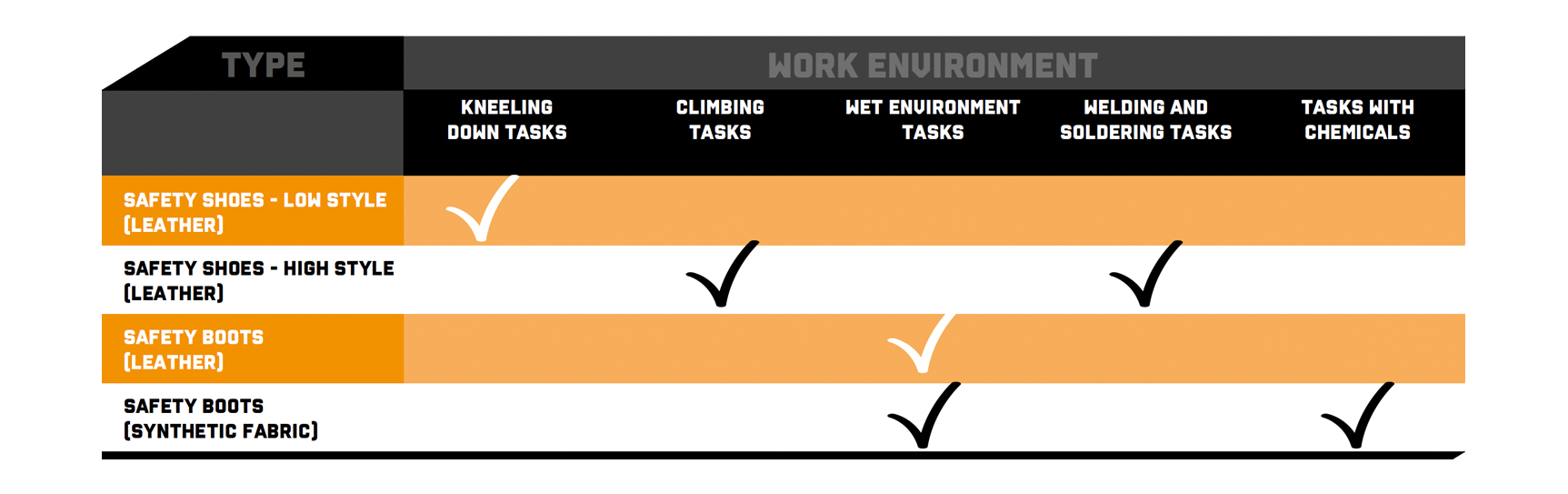
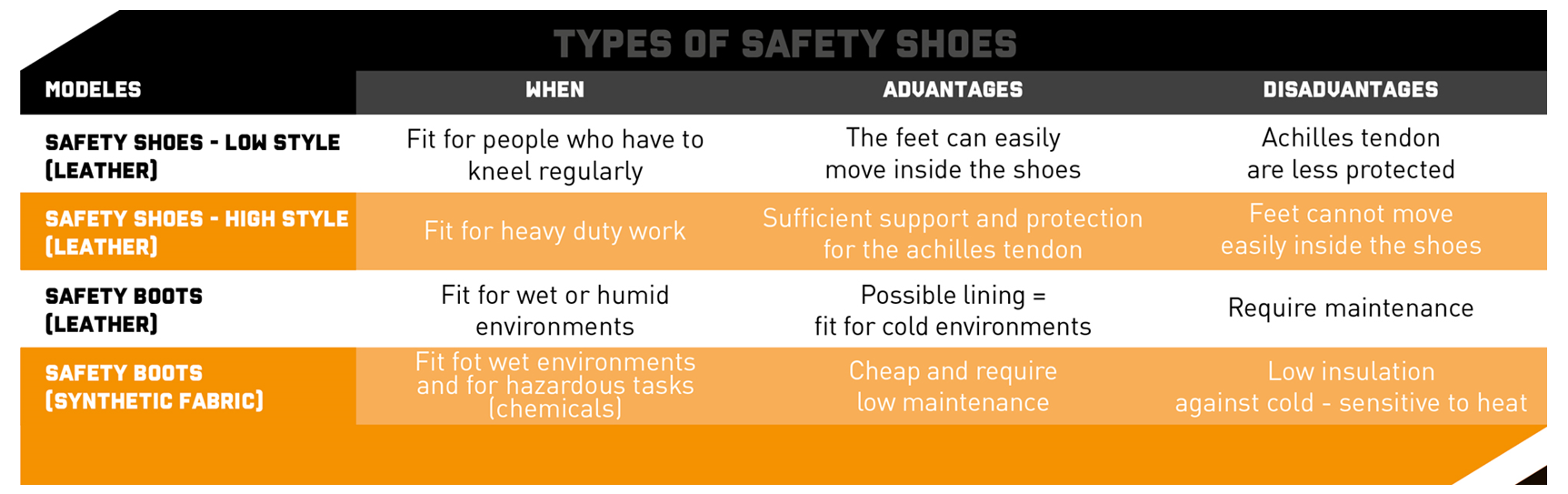
Different sectors of activities
Construction Industry >>
S3 safety shoes - You will be protected from hydrocarbons or perforations. Styles that are antistatic, non-slippery and with a safety toecap.
Healthcare >>
Easy to put on and take off, very light, they are practical to wear all day with a polyurethane sole, which offers unparalleled comfort and great cushioning. Moreover, this sole is removable and therefore very easily washable, just like the rest of the shoe made of microfibre, they are antistatic and waterproof.
Food-Processing Industry >>
Non-slippery, waterproof and hard-toed shoes
(one toecap for extra protection).
Services >>
Non-slippery, water-resistant shoes with comfortable insoles.
Mechanical/Plumbing industries >>
S3 safety shoes to prevent perforations and shocks. The protective shells will prevent any shocks in case of falling objects. It is a flexible sole that gives you extra comfort when working on your knees.
Handling >>
S1P safety shoes - You move around a lot and change positions, so you need flexible, lightweight shoes with anti-puncture soles. No metal, anti-static, shock absorbing heel, hydrocarbon resistant sole, anti-puncture and waterproof protection are its main assets.
Security >>
Shoes with high or mid-high uppers: these uppers provide good support for the ankles. Shoes with reinforced soles or rubber soles: they cushion the shocks.